Hotel Injury Lawyer Tennessee: Resort Injury Claims, Liability for Unsafe Conditions in Sevier County and the Smoky Mountains
This guide is for hotel guests, tourists, and families injured at hotels in Tennessee who are seeking legal options and guidance. When a property owner fails to keep their premises safe, the consequences for guests can be devastating. If you or a family member suffered a hotel injury in Tennessee, you may have legal options under the state's premises liability law, but critical deadlines and procedural rules mean the time to act is now. Understanding your rights and the legal process is crucial to protecting your health and financial future after a hotel injury.
Key Takeaways
Hotel injuries in Sevier, Blount, Knox, Loudon, Jefferson, and Cocke Counties are typically premises liability claims rooted in hotel negligence and unsafe conditions. A lawyer's familiarity with Tennessee premises liability law is crucial when handling these cases.
Injured hotel guests and their family members may pursue hotel injury claims for falls, pool accidents, criminal attacks, carbon monoxide poisoning, and other hazards. You can sue a hotel if they failed to maintain safe conditions.
Tennessee's one-year statute of limitations and modified comparative fault rule (which bars recovery if a guest is 50% or more at fault) make it critical to act quickly after a hotel accident.
To find a hotel injury lawyer in Tennessee, look for attorneys specializing in premises liability. Contact DZ Law, PLLC for help with hotel injury cases in Sevier County and the Smoky Mountains. Call (865) 259-0020 or message us online for a free premises liability consultation.
DZ Law handles complex premises liability litigation and appeals, including hotel and resort injury claims involving serious personal injuries and wrongful death.
Hotel and Resort Injuries in Sevier County and the Smoky Mountains
Legal Duty of Hotels and Resorts
Hotels, resorts, and lodges in Pigeon Forge, Sevierville, Gatlinburg, Townsend, and throughout the Smoky Mountains have a legal duty to keep their hotel property reasonably safe for hotel guests. Tennessee law treats these properties the same as any other commercial premises: property owners must maintain safe conditions for guests and take reasonable steps to address known hazards.

Unique Risks in East Tennessee Hotels
Tourism in eastern Tennessee, especially Sevier County and neighboring Blount and Knox Counties, drives enormous occupancy rates and constant guest turnover. That volume, combined with mountainous terrain, seasonal weather, and aging infrastructure at some properties, creates conditions where hotel guest injuries occur regularly. Falls are the most common hotel guest injuries, but balcony failures, pool accidents, and carbon monoxide incidents happen as well.
Premises Liability Claims
Hotel injury cases in Tennessee are generally premises liability claims. The central question is whether the hotel or resort failed to correct or warn about a dangerous condition on the property. DZ Law, PLLC, based in Blount County and serving clients throughout Sevier, Blount, Knox, Loudon, Jefferson, and Cocke Counties, represents injured hotel guests and their families in serious hotel injury claims.
Common Types of Hotel Injuries in Tennessee
The range of injuries that occur at Smoky Mountain and east Tennessee hotels is broader than most guests expect. Common hotel injuries include:
Slips, Trips, and Falls
Slips, trips, and falls in lobbies, hallways, stairwells, and parking lots
Wet floors, worn carpet, uneven surfaces, or poor lighting
Slippery surfaces and broken railings
Falls are the single largest category of hotel accident results nationwide
Pool and Hot Tub Accidents
Pool and hot tub accidents, including drownings and near drowning incidents
Suction and drain injuries
Lack of lifeguards
Improperly maintained chemical levels
Hot tub temperature malfunctions causing burns
Balcony and Deck Collapses
Balcony and deck collapses or falls from defective railings
Structural defects that went unrepaired
Faulty Equipment in Fitness Centers
Broken treadmills or weight machines
Equipment not properly maintained or inspected
Burns and Smoke Inhalation
Burns and smoke inhalation from hotel fires
Faulty wiring, overloaded outlets, space heaters
Non-functioning smoke detectors
Tennessee law requires smoke alarms in rental properties and hotel sleeping rooms under Tenn. Comp. R. & Regs. 1200-23-04-.02
Other Injuries
Elevator malfunctions
Falling objects
Contaminated food or water
These hotel injuries can lead to fractures, traumatic brain injuries, spinal cord damage, internal injuries, and wrongful death, resulting in significant economic damages and long-term care needs.

Examples of Hotel Negligence That Can Lead to Liability
Not every hotel accident leads to a legal claim. Liability arises when hotel negligence, meaning a failure to act reasonably, creates or allows a dangerous condition that causes harm. Hotels must address slip and fall hazards promptly and maintain a safe environment for guests at all times.
Negligent Maintenance
Ignoring reports of loose handrails
Failing to repair broken railings on stairs and balconies
Allowing water, grease, or cleaning solution to remain on floors without warning signs
Neglecting icy walkways during winter weather
Failing to replace burned-out lights in stairwells, parking garages, or exterior corridors
Negligent Operations
Understaffed housekeeping
Inadequate inspections of guest rooms and common areas
Failure to follow the hotel's own written safety policies
Negligent Training and Supervision
Employees not taught how to respond to spills, security incidents, or fire alarms
Evidence of Prior Complaints
Pattern of incident reports, guest feedback, or online reviews showing the same hazard
Repeated complaints about a slippery pool deck
DZ Law's premises liability practice focuses on investigating and proving these types of failures in court or arbitration when needed.
Criminal Attacks and Negligent Security at Tennessee Hotels
Negligent Security Scenarios
Hotel guests can suffer assaults, robberies, and sexual attacks when hotels fail to provide reasonable security measures. These incidents are particularly common in parking lots, stairwells, and exterior corridors where security personnel are absent and lighting is poor.
Broken or missing door locks on guest rooms
Propped-open exterior doors that allow unauthorized entry
Lack of security cameras or surveillance footage in known trouble areas
Inadequate lighting in parking garages or walkways
Absence of security personnel during high-risk hours
Negligent security can lead to guest assaults in hotels. Prior criminal activity on or near the hotel property, documented by police reports or 911 calls, can make future criminal attacks foreseeable and increase the hotel's duty to protect guests.
In negligent security hotel injury cases, the legal claim targets the hotel or property owner for failing to take reasonable steps to protect guests' safety, not the criminal alone. DZ Law's premises liability and appeals practice can be critical in complex negligent security cases that may involve extensive discovery, expert testimony, and potential appellate issues.
Carbon Monoxide Poisoning and Hidden Hotel Hazards
Carbon Monoxide Risks
Carbon monoxide poisoning is a serious but often silent hotel injury risk in Tennessee. Older motels and lodges with gas-fired appliances or attached garages are particularly vulnerable. Carbon monoxide poisoning can occur from faulty hotel appliances, including malfunctioning boilers, furnaces, water heaters, or pool heaters, especially when ventilation is inadequate.
Detector Requirements and Legal Duties
Carbon monoxide detectors are required in hotels. Under Tenn. Code § 68-120-112, hotels operating fossil-fuel-burning appliances must install approved CO alarms within 10 feet of each room used for sleeping. Carbon monoxide detectors are required in many lodging settings, and noncompliance is a Class C misdemeanor per day of violation. Missing, disabled, or non-functioning detectors may constitute hotel negligence and strongly support a hotel injury claim.
Symptoms and Other Hidden Hazards
Symptoms of CO exposure include headache, dizziness, nausea, and confusion. Guests are often sleeping when exposed, making properly functioning detectors and safety systems critical.
Beyond carbon monoxide, other hidden hazards such as mold, contaminated water, or unsafe hot water temperatures can cause serious injuries or illnesses for which hotels may be held liable.
Who May Be Responsible for a Hotel Injury in Tennessee?
Modern hotels and resorts in Sevier County and surrounding counties often involve multiple business entities, all of which may share responsibility for a hotel accident. Identifying all potentially responsible parties is essential to maximizing financial recovery.
Potentially Responsible Party | Role |
|---|---|
Local hotel owner | Owns the physical property |
National brand or franchisor | Sets standards, may control operations |
Management company | Day-to-day operations, staffing, maintenance |
Security contractor | Hired to protect guests and property |
Pool maintenance company | Chemical balance, drain safety, equipment |
Cleaning or snow/ice removal vendor | Addresses hazards on walkways and lots |
Chain hotels are frequently franchised operations, requiring investigation into who actually controlled maintenance, housekeeping, and security procedures. DZ Law's business and commercial litigation experience allows the firm to analyze ownership structures, management contracts, and insurance arrangements in complex hotel injury cases, ensuring that all responsible parties are held accountable.
What You Should Do Immediately After a Hotel Accident
The first steps after a hotel injury can greatly affect your ability to bring a strong hotel injury claim later. In Tennessee, where evidence can disappear quickly and the statute of limitations is short, early action matters.
Seek medical attention immediately. Get checked by a medical professional, even if injuries seem minor. This creates a medical record linking injuries to the incident and becomes essential physical evidence.
Report the incident to hotel management. Request a written incident report and ask for a copy. Note the manager's name, and the date and time of the report.
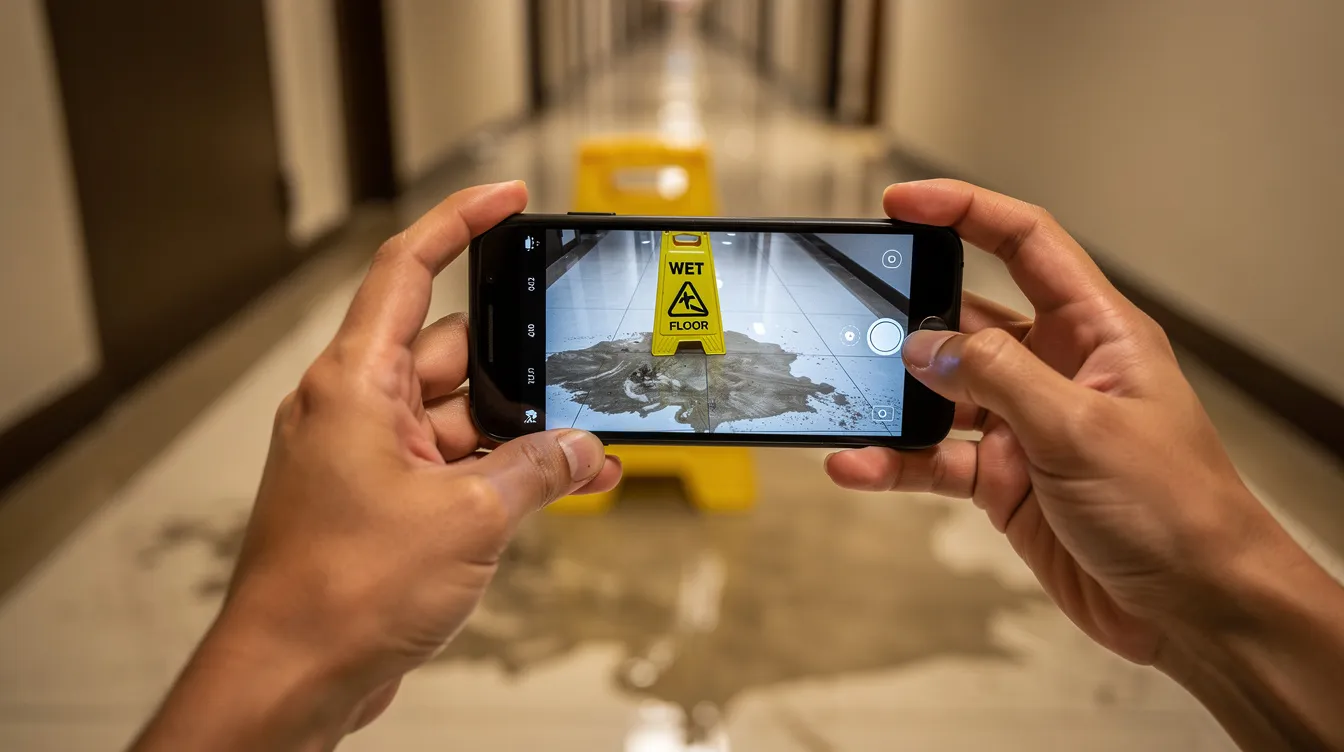
Document the hazard. Take photos and videos of the dangerous condition (wet floor, broken railing, missing smoke detector, poor lighting) and of visible injuries to preserve evidence.
Collect witness information. Get contact details from other guests or hotel staff who saw the accident or the dangerous condition beforehand. Witness statements can become strong evidence in your case.
Do not sign releases or settlement offers. Do not sign blanket releases, waivers, or settlement agreements from the hotel or its insurer before speaking to an attorney familiar with Tennessee premises liability law.
Proving a Hotel Injury Claim Under Tennessee Premises Liability Law
Tennessee hotel injury claims are typically premises liability cases requiring proof of specific legal elements. Tennessee has specific laws governing premises liability that must be proven in court.
Elements of a Premises Liability Lawsuit
The hotel owed a duty of care to the guest
A dangerous condition existed on the hotel property
The hotel knew or should have known of the danger (notice)
The hotel failed to fix the condition or warn guests about it
That failure caused the guest's injuries and damages
Notice can be either actual or constructive. Actual notice means hotel staff actually knew about the hazard, perhaps through prior complaints or incident logs. Constructive notice means the hazard existed long enough that the hotel should have known about it through reasonable inspection routines. For example, a spill left on a lobby floor for several hours without cleanup may establish constructive notice.
Maintenance records, inspection logs, security policies, incident reports, and surveillance footage are all critical in proving that the hotel failed in its legal duty. Hotels are liable for injuries from known hazards, and property owners can be liable for injuries from known hazards even when those hazards may seem minor.
Under the Restatement (Second) of Torts § 343A, Tennessee no longer treats an obviously dangerous condition as an automatic bar to liability. Courts balance foreseeability, gravity of harm, and the burden of prevention.
DZ Law's premises liability team works to quickly request and preserve this evidence, sometimes through litigation or emergency court orders when needed.
How Tennessee's Comparative Fault Rule Affects Hotel Injury Cases
Tennessee follows a modified comparative fault rule allowing recovery if you are less than 50% at fault. Under Tennessee's comparative fault statute, a jury assigns percentages of fault to each party, and damages are reduced proportionally.
How Comparative Fault Works
If a jury finds a hotel guest 20% responsible (for example, not using an available handrail) and the hotel 80% responsible (for failing to fix a loose stair tread), the guest's compensation is reduced by 20%.
If the guest is found 50% or more at fault, Tennessee law bars any recovery entirely.
This makes fault allocation a central battle in hotel injury cases. Hotel insurers and defense attorneys frequently argue that guests were distracted, intoxicated, or ignored warnings to reduce payouts, especially in tourist-heavy areas like Pigeon Forge and Gatlinburg.
DZ Law develops evidence to counter these arguments, showing that hazards were not obvious, guests were behaving reasonably, and the hotel's negligence was the primary cause of the injuries caused.
Deadlines: Tennessee's One-Year Statute of Limitations for Hotel Injuries
In most Tennessee hotel injury cases, you have one year to file a personal injury claim in Tennessee. This deadline is set by Tennessee Code Annotated § 28-3-104 and applies whether the injured person is a Tennessee resident or an out-of-state visitor hurt while staying at a Tennessee hotel.
Certain circumstances, such as claims involving minors or related criminal prosecutions, can affect deadlines, but these exceptions are tightly construed and should never be assumed without legal consultation.
Waiting too long can permanently bar your hotel injury claim, even if liability is clear. Insurance companies are aware of this deadline and may delay negotiations, knowing that time is running out for the injured party.
Contact DZ Law as soon as possible to review deadlines and preserve your rights. Call (865) 259-0020 or send us a message online today.
Damages Available in Tennessee Hotel Injury Claims
Damages in hotel injury claims are intended to compensate for both economic and non-economic losses caused by hotel negligence. Guests can recover damages if property owners are negligent.
Economic Damages
Victims can claim economic damages for medical bills and lost wages. Economic damages include:
Past and future medical expenses and medical treatment costs
Rehabilitation and physical therapy
Lost wages and diminished earning capacity
Out-of-pocket costs for travel and accommodations related to treatment
Home care or modifications when needed
Economic damages are not subject to any cap under Tennessee law.
Non-Economic Damages
Non-economic damages compensate for pain and suffering, including:
Physical pain and emotional distress
Loss of enjoyment of life
Loss of consortium for a spouse or family member
Tennessee caps non-economic damages at $750,000 for most personal injury cases, though exceptions exist for catastrophic injuries. These caps can be especially important in severe hotel injury or wrongful death cases.
Punitive Damages
In rare cases involving reckless or intentional misconduct, such as knowingly disabling fire alarms or ignoring known carbon monoxide leaks, punitive damages may apply for especially reckless conduct. These damages punish and deter egregious behavior by hotel owners.
DZ Law evaluates all categories of damages, including long-term impacts and future costs, when negotiating or litigating premises liability cases to help injury victims recover compensation and achieve meaningful financial compensation.
Out-of-State Visitors Injured at Tennessee Hotels
Many hotel guests in Sevier County, the Smoky Mountains, and Knoxville are from other states. If you suffered a hotel injury while visiting, you still have strong rights under Tennessee law.
Lawsuits for hotel injuries are typically filed in Tennessee, where the hotel is located and the accident occurred, even if the guest lives elsewhere. Tennessee law governs these personal injury cases regardless of the guest's home state.
You do not always have to return to Tennessee for every step of the case. Much communication with DZ Law can occur by phone, video conference, and secure electronic document exchange. The firm regularly assists tourists and visitors who were injured during stays in east Tennessee hotels, cabins, and resorts and then returned home.
If you were injured at a Tennessee hotel but live in another state, call (865) 259-0020 or contact us online to discuss your legal options without traveling back just to meet with a local lawyer.
How DZ Law, PLLC Handles Hotel and Resort Injury Cases
DZ Law's premises liability practice is part of a broader complex civil litigation law firm that also handles construction litigation and arbitration, business and commercial litigation, medical malpractice, appeals and federal court litigation, and business transactions and contracts. That breadth is directly valuable in complicated hotel injury claims, where disputes may involve franchisors, management companies, or complex indemnity provisions.
DZ Law's Process
Free consultation to evaluate the merits and value of your claim
Detailed factual investigation, including preservation of surveillance footage, maintenance records, and incident reports
Identification of all liable parties and evaluation of available insurance coverage
Aggressive negotiation backed by litigation readiness
Insurance companies will negotiate differently with proven trial lawyers, enhancing settlement leverage. When settlement negotiations fail, DZ Law is prepared to litigate hotel negligence cases in trial courts across Sevier, Blount, Knox, Loudon, Jefferson, and Cocke Counties and to handle appeals and federal court issues if they arise. Investigative resources are essential for attorneys handling hotel injury claims, and DZ Law invests in the expert analysis, engineering testimony, and documentary evidence needed to build the strongest possible case.
To speak with a Tennessee hotel injury lawyer about your case, call (865) 259-0020 or send DZ Law a confidential message online for a no-cost case evaluation.
Coordinating Hotel Injury Claims with Insurance and Medical Bills
Hotel injury victims often face immediate medical bills and health insurance questions long before their personal injury claim is resolved. Health insurers, Medicare, or other payers may assert reimbursement or subrogation rights against a settlement or judgment, based on plan language and Tennessee law.
Do not ignore medical collections, but let your attorney know about all insurers and medical providers so potential liens or reimbursement claims can be addressed during settlement negotiations. DZ Law has experience handling subrogation and reimbursement issues in personal injury cases, helping clients understand whether and how much must be paid back from any financial recovery.
A well-structured resolution can help maximize the client's net recovery after satisfying lawful liens or reimbursements. Understanding these dynamics early in the process keeps more money in the pockets of injury victims and their families.
When a Hotel Injury Becomes a Wrongful Death Claim
Some hotel accidents in Tennessee, such as fatal falls, drownings, fires, or carbon monoxide poisoning, tragically result in the loss of a family member. Tennessee law allows certain family members, including a surviving spouse, children, or parents, to bring a wrongful death claim on behalf of the deceased person.
Potential Damages in Wrongful Death Cases
Funeral and burial expenses
Loss of the decedent's earning capacity
Loss of consortium and companionship
The decedent's own physical pain and suffering prior to death
The one-year statute of limitations generally applies to wrongful death arising from hotel negligence, making early legal advice essential. If your family lost a loved one in a hotel accident, DZ Law is here to help you understand your rights, pursue accountability, and seek the financial recovery your family deserves.
Frequently Asked Questions About Tennessee Hotel Injury Claims
Do I have a case if I tripped but the hotel immediately fixed the hazard?
Repairs made after an accident do not erase the hotel's prior negligence. However, evidence of the dangerous condition before repair becomes extremely time-sensitive. Photographs, witness statements, and testimony about what the condition looked like are critical. Contact an attorney quickly so that evidence can be preserved before it disappears.
What if I signed a hotel registration form or waiver before my stay?
Standard registration forms and many liability waivers do not automatically prevent guests from bringing hotel injury claims in Tennessee, especially when the hotel failed to maintain basic safety standards. Enforceability depends on the specific contract language and Tennessee law. DZ Law can review any documents you signed to advise whether your rights were actually limited.
Can I recover if my child was injured at a hotel pool or play area?
Children injured at hotel pools, splash pads, or playgrounds may have claims if unsafe conditions, inadequate supervision, or code violations contributed to the injury. Claims involving minors follow special rules for statutes of limitations and settlement approvals. Parents should consult a Tennessee premises liability attorney promptly to protect their child's rights.
How much does it cost to hire DZ Law for a hotel injury case?
Personal injury attorneys in Tennessee typically work on a contingency fee basis. DZ Law handles hotel injury and other premises liability cases this way, meaning clients pay no attorney fee unless there is a financial recovery. The initial consultation is free, and fee structure and costs are explained clearly at the outset of representation. You can also use the Tennessee Bar Association directory to search for licensed personal injury attorneys and verify credentials.
What information should I have ready before contacting DZ Law?
Gather basic details about the hotel accident: name and location of the hotel, date and time of the incident, photos or videos, names of witnesses, copies of the incident report, and any medical records or medical bills received so far. Even if you do not yet have all documents, call (865) 259-0020 or message DZ Law online so the firm can advise on next steps and evidence preservation. Short term rentals, cabins, and resort properties are all covered by Tennessee's premises liability framework, and early action is always in your best interest.